At the United Nations Climate Change Conference (COP30) held in Belém, Brazil, from 10 to 21 November 2025, the Gender and Energy Compact organized a series of gender-related side events, raising awareness about the need for gender equality and women’s empowerment and putting gender transformative action center stage. The Compact spotlighted gender-transformative climate and energy solutions, inclusive strategies, enabling financing mechanisms, data-driven approaches and multi-sector collaboration to accelerate equitable energy transitions.
In the lead up to COP30, the Gender and Energy Compact together with the COP30 Presidency, Climate Champions Team and UNFCCC organized a virtual workshop to explore effective approaches for integrating gender equality into climate solutions.
The Gender and Energy Compact also supported the COP30 Presidency Climate Action Agenda by leading or contributing to Plans to Accelerate Solutions (PAS), including on universal access to clean cooking, education for new generations and new skills development.
At COP30, Parties adopted the new Belém Gender Action Plan, a nine-year roadmap to integrate gender equality into climate action. The plan strengthens commitments by addressing health, violence prevention, and protection for women environmental defenders. It emphasizes just transitions, decent work, and care responsibilities, while recognizing the unique challenges faced by Indigenous women, women with disabilities, and rural communities. Countries are urged to ground actions in human rights and provide financial and technical support. UN Women hailed it as a “blueprint for action” for gender-responsive climate policy over the next decade. The Gender and Energy Compact welcomes this milestone and looks forward to supporting its implementation across energy and climate initiatives.
Over the two COP30 weeks, the Gender and Energy Compact participated in 18 events. Several events were hosted by signatory INCLUDE in its COP30 pavilion. Here are some of the highlights.
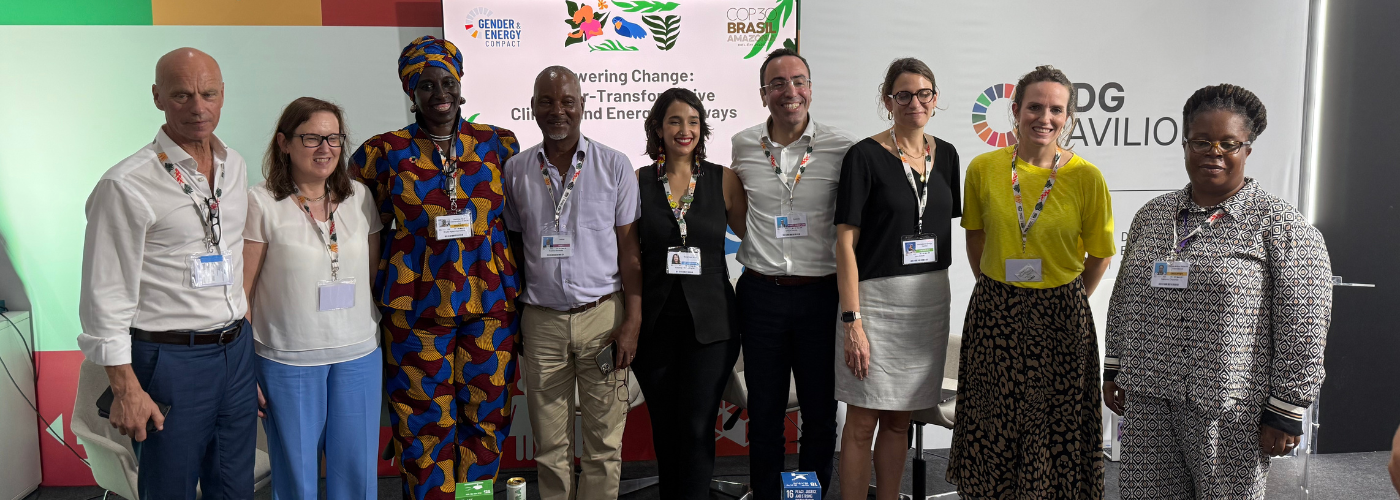
Powering Change – Gender-Transformative Climate and Energy Pathways
12 November 2025: Moderated by Hans Olav Ibrekk from the Norwegian Ministry of Foreign Affairs, this session convened representatives from governments, international organizations, and the private sector to advance gender equality in climate action and energy transitions. The session showcased practical solutions and mobilized commitments ahead of the adoption of the revised UNFCCC Gender Action Plan and the 2026 SDG7 review.
Panelists from Iceland, Malawi, the UK, International Energy Agency, MPower Brazil, ENERGIA and the Private Infrastructure Development Group shared experiences and strategies to accelerate inclusive transitions. Participants called for stronger coordination, gender-responsive policies backed by data and financing, and greater recognition of women’s economic agency.
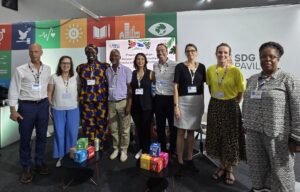
PAS Implementation Workshop on New Skills Development to Empower Women and Youth for a Just Transition
12 November 2025: This event was co-organized by UNIDO and ILO with partners including Care About Climate, Student Energy, the Gender Energy Compact, IRENA, and FAO’s WFF Youth Initiative. The session aimed to discuss the Plan to Accelerate Solutions (PAS) around gender- and youth-responsive skills development. The discussion highlighted the need for integrated strategies combining technical training, supportive policy frameworks, and access to finance to advance a just transition. Participants emphasized inclusive participation in decision-making and empowering women and youth as leaders in climate action. The workshop reinforced UNIDO’s role in embedding gender equality and youth empowerment in industrial decarbonization and sustainable energy programs, demonstrating the importance of skills development for achieving the Paris Agreement and SDG7.

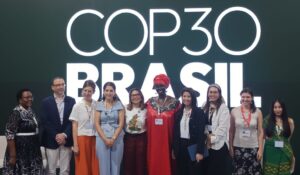
High-level Solutions Dialogue: Turning Gender Commitments into Climate Impact
13 November 2025: This session brought together governments, civil society, private sector, and youth to accelerate gender-transformative climate and energy action. Co-hosted with the Clean Energy Ministerial Equality Initiative and other partners, and moderated by Ms. Sheila Oparaocha, Director of the ENERGIA International Network on Gender and Sustainable Energy, the dialogue focused on moving from commitments to measurable impact in nationally determined contributions, just transition strategies, and Plans to Accelerate Solutions.
The First Lady of Brazil and COP30 Special Envoy for Women, Ms. Janja Lula da Silva, called for gender to be positioned at the core of climate policy: “Women must not be seen merely as beneficiaries. They are farmers, activists, engineers, and so much more.”
Representing the Compact, Ms. Rana Ghoneim, Director of the Division of Energy and Climate Action, UNIDO, emphasized the Gender and Energy Compact’s work in integrating gender considerations in sustainable energy frameworks. She stressed that “Gender equality is not peripheral to climate action. It is foundational to its success. Inclusive energy systems are more resilient, more innovative, and more impactful.”
Speakers from Costa Rica, Guatemala, Germany, and Uganda (representing also the Least Developed Countries Group on Climate Change) showcased gender-responsive action and called for scaling solutions. Ms. Gaby Lika Inga, a young indigenous representative from Indonesia reminded delegates: “The climate crisis is a gender crisis – is a youth crisis – is a crisis of injustice… Great things happen when we invest in women and girls, in youth, and in Indigenous communities.”
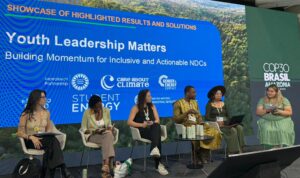
Youth Leadership Matters: Building Momentum for Inclusive and Actionable NDCs
14 November 2025: Organized together with Student Energy and Care about Climate, this youth-led event emphasizes that nationally determined contributions (NDCs) are a shared responsibility across professions, generations, and communities.
From agriculture and energy systems to marketing, education, and beyond, the event spotlighted how young people across diverse sectors can turn NDCs into action with examples from least developed countries and Europe. Youth representatives highlighted the role of youth networks and groups in driving inclusive implementation. They also pointed out that now is the time to turn the NDCs into policies and actions that promote inclusion and put youth at the center of the climate agenda.
With voices from diverse sectors, the event highlighted how education, capacity building, and innovation can empower youth to implement inclusive, people-centered climate solutions.
From Transition to Transformation: Centering Women, Youth and Communities in the Caribbean’s Energy Transition
17 November 2025: Hosted by the Caribbean Centre for Renewable Energy and Energy Efficiency (CCREEE) and co-organized jointly with the Global Network of Regional Sustainable Energy Centres (GN-SEC), this regional dialogue explored how equitable, inclusive, and locally led approaches can shape a just energy transition across the Caribbean.
The session spotlighted the leadership and resilience of women, youth and communities in small island developing states and highlighted how sustainable energy and climate finance drive adaptation and social transformation.
During the event, CCREEE reconfirmed its commitment to advancing gender equality and women’s leadership by officially joining the Gender and Energy Compact.
The event ended with a call to action for gender equality, intergenerational equity, community empowerment, and climate adaptation in the Caribbean.